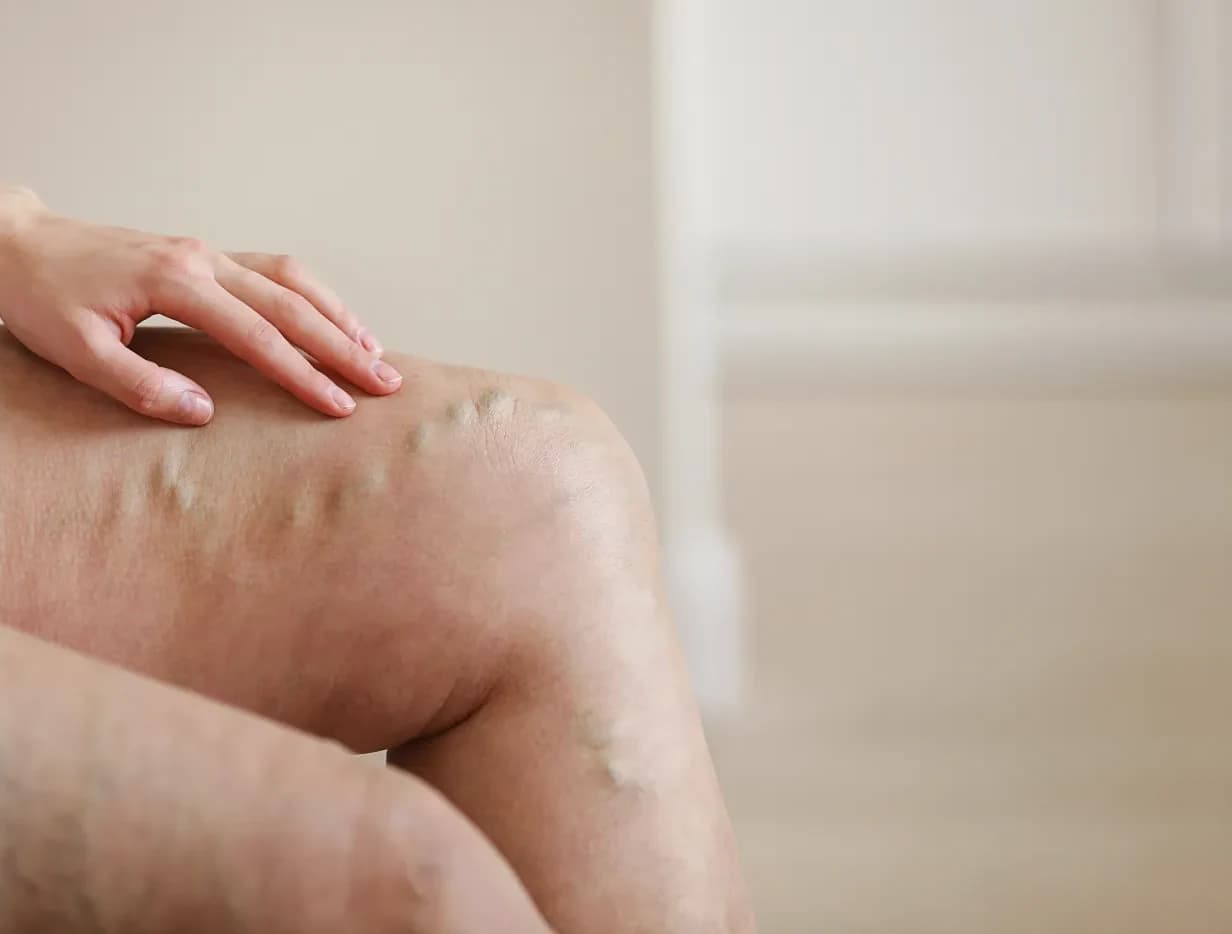
Varicose veins are a medical condition — not just cosmetic.
Bulging, ropy veins are a sign that the valves inside your veins are no longer working. Left untreated, they get worse — but they respond extremely well to minimally invasive, outpatient treatment.
What varicose veins really are
Healthy leg veins move blood up against gravity using one-way valves. When those valves fail, blood pools in the veins below — and the wall of the vein stretches outward into the rope-like bulges you can see at the surface. This is called venous reflux, and it's the root cause behind most varicose veins.
Because the underlying problem is mechanical — a failed valve — varicose veins do not go away on their own, and they tend to progress slowly over years.
What starts as a cosmetic concern can evolve into swelling, restless legs, skin discoloration, and in advanced stages, non-healing wounds at the ankle.
The good news: modern minimally invasive treatments can close the failed vein in under an hour, in our Pompano Beach office, with no general anesthesia and no overnight stay. Most patients return to normal activity the same day.
When to be evaluated
Varicose veins are medical when they cause symptoms — and most do, even if you've learned to live with them. Common signs that warrant evaluation:
Vein disease is progressive.
Once a vein's valves fail, the venous pressure downstream increases. Over time, that pressure damages capillaries and skin tissue at the ankle — leading to chronic venous insufficiency, skin changes, and eventually venous ulcers that can take months to close. The earlier we close the failed vein, the easier the recovery and the lower the risk of permanent skin damage.
Dr. Anton has spent over 20 years treating vascular disease — and because his background bridges nephrology and vein medicine, he sees the whole circulatory picture, not just the surface vein. That matters when symptoms overlap with arterial disease, lymphatic issues, or kidney-related fluid retention.
Do your symptoms match?
Take our 5-question assessment to understand your risk level and whether treatment may be right for you.
How long have you had visible veins or leg discomfort?
A consultation, then a plan.
Your first visit includes a clinical exam and a duplex ultrasound — a painless scan that maps which veins have failed valves and how severe the reflux is. From there, Dr. Anton walks you through options: compression, lifestyle changes, or one of several minimally invasive procedures (venous ablation, sclerotherapy, or venous angioplasty depending on the case).
All procedures are performed in our Pompano Beach office, take under an hour, and use only local anesthesia. Most patients walk out and resume normal activity the same day — with the only restriction being no heavy lifting or strenuous exercise for about a week.
Frequently asked questions
Are varicose veins just a cosmetic problem?
They can look cosmetic, but bulging, ropy veins are a sign that the valves inside your veins have failed (venous reflux). Because the problem is mechanical, it tends to progress — so evaluation is worthwhile even when symptoms are mild.
Do varicose veins go away on their own?
No. The underlying valve failure doesn't self-correct, so varicose veins tend to worsen slowly over years rather than resolving.
When should I see a vein specialist?
If you have visible bulging veins, aching or heavy legs, ankle swelling after standing, itching or restless legs at night, or a non-healing sore near the ankle, it's worth being evaluated — earlier treatment means easier recovery.
Is varicose vein treatment covered by insurance?
When veins cause symptoms they're considered medical rather than cosmetic, and most plans including Medicare cover the evaluation and treatment.
What does treatment involve?
Procedures are performed in the Pompano Beach office, take under an hour, and use only local anesthesia. Most patients resume normal activity the same day, avoiding heavy lifting or strenuous exercise for about a week.
answers?